Modern office life often means spending hours in front of a computer, sitting through meetings, answering emails and working at a desk. While technology has made work easier, long periods of sitting and limited movement can leave many people dealing with stiff shoulders, tight hips, back discomfort, neck tension and poor posture.
This is where Pilates for office workers can become a valuable part of a healthy movement routine.
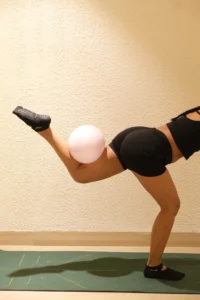
Pilates focuses on controlled movements, core strength, body awareness, flexibility, stability and posture. For people who spend much of their day sitting, these principles can complement regular movement and help build better physical habits.
Research on office workers also suggests that exercise can help with work-related neck and back symptoms, while studies specifically examining Pilates have reported potential benefits for posture and musculoskeletal health.
Why Do Office Workers Experience Back and Neck Discomfort?
A typical desk job may involve sitting for several hours with relatively little movement. Office workers can also spend long periods looking at screens, typing, using a mouse or holding the same position during meetings.
A recent review of office-worker research found that longer sitting, fewer breaks and more static sitting behaviour were associated with low back pain in a number of studies.
Common issues associated with prolonged desk work include:
- Stiff neck and shoulders
- Upper-back tension
- Lower-back discomfort
- Tight hip flexors
- Reduced mobility
- Weak or underactive core muscles
- Rounded shoulder posture
- Poor body awareness
- General stiffness after sitting
However, discomfort should not automatically be blamed on one posture or one activity. Individual factors, workload, sleep, stress, physical fitness, workstation setup and movement habits can all play a role.
That is why Pilates for Office Workers should be viewed as part of a broader movement and wellness strategy rather than a quick fix.
How Can Pilates Help Office Workers?
Pilates combines controlled movement with breathing, concentration, coordination and core engagement. These principles can be particularly useful for people whose working day involves prolonged sitting.
1. Supports Better Posture
One of the most important benefits of Pilates for office workers is its emphasis on body awareness.
Pilates exercises encourage you to understand how your head, shoulders, spine, pelvis and limbs move together. This awareness can make it easier to recognise habits such as slouching or excessive tension.
A systematic review examining Pilates and body posture found evidence suggesting that Pilates can improve postural problems, although the quality of individual studies varied.
Better posture is not about maintaining one rigid position all day. Instead, the goal is to develop strength, mobility and movement awareness so you can change positions comfortably.
2. Strengthens the Core
Your core provides support for many everyday movements.
For office workers, developing core strength can be useful because sitting for long periods does not necessarily challenge the muscles in the same way as active movement.
Pilates includes exercises that engage the abdominal muscles, back muscles and muscles around the pelvis.
A stronger and more coordinated core can support everyday activities such as:
- Sitting and standing
- Walking
- Bending
- Lifting
- Reaching
- Changing positions
3. Helps Improve Spinal Mobility
Spending hours in one position can make the body feel stiff.
Many Pilates movements involve controlled spinal flexion, extension and rotation. When performed appropriately, these movements can encourage people to move their spine through different ranges rather than remaining static throughout the working day.
For office workers, this can be especially useful as part of a balanced exercise programme.
4. Addresses Neck and Shoulder Tension
Computer-based work often requires sustained visual attention and repetitive upper-body movements.
Exercises that develop strength and endurance in the neck, shoulders and upper back may help office workers manage neck-related symptoms. A systematic review and meta-analysis found that strengthening exercises can reduce neck pain and disability in office workers, although the certainty of evidence was considered low.
Pilates for Office Workers can incorporate controlled upper-body movements, shoulder stabilisation and postural awareness alongside broader strengthening exercises.
5. Improves Hip Mobility
The hips can spend much of the working day in a flexed position when you sit.
Pilates can include movements that challenge hip mobility and strengthen the muscles surrounding the hips and pelvis.
Improving mobility does not mean forcing a deep stretch. Controlled, comfortable movement is more important than trying to achieve extreme flexibility.
6. Encourages Mindful Movement
Pilates is not simply about completing repetitions.
The method places emphasis on concentration, breathing, control and precision. This can help office workers become more aware of how they move and where they hold unnecessary tension.
That awareness can translate into everyday habits, such as changing positions more frequently, relaxing the shoulders and taking movement breaks.
7 Pilates Exercises for Office Workers
The following movements can be incorporated into a suitable Pilates routine. Beginners should learn proper technique from a qualified instructor, particularly if they have existing pain or movement limitations.
1. Pelvic Tilts
Pelvic tilts are a simple movement for developing awareness of the pelvis and lower back.
Lie comfortably on your back with your knees bent. Gently move your pelvis so that your lower back changes contact with the floor.
The movement should be controlled rather than forced.
Potential focus: pelvic awareness and gentle spinal movement.
2. Cat-Cow
Cat-Cow involves moving between gentle spinal flexion and extension.
Start on your hands and knees. Slowly round your spine and then move toward a comfortable extended position.
This exercise can be useful for people who spend much of their day sitting because it introduces movement into the spine.
Potential focus: spinal mobility and movement awareness.
3. Chest Opening
Office work can involve prolonged forward-reaching positions.
A simple chest-opening movement can help counterbalance some of these movement demands.
Sit or stand tall, gently draw your shoulders back and down, and open through the chest without forcing the movement.
Potential focus: shoulder positioning and upper-body mobility.
4. Shoulder Blade Movement
Controlled shoulder blade movements can help develop awareness of the muscles around the upper back and shoulders.
Move your shoulders gently through elevation, depression and controlled retraction without shrugging excessively.
Potential focus: shoulder mobility and upper-back control.
5. Glute Bridge
The glute bridge is a common Pilates exercise that works the muscles around the hips and pelvis.
Lie on your back with your knees bent. Press through your feet and lift your pelvis in a controlled manner before slowly lowering.
Potential focus: glute strength, pelvic control and posterior-chain activation.
6. Bird Dog
Bird Dog challenges balance, coordination and core control.
From a hands-and-knees position, extend the opposite arm and leg while maintaining a stable trunk.
The goal is not to lift the limbs as high as possible. Maintaining control is more important.
Potential focus: core stability, balance and coordination.
7. Spine Stretch
Spine Stretch is a Pilates movement designed to encourage controlled spinal movement and lengthening.
Sit comfortably with the legs positioned according to your ability. Maintain an upright starting position and slowly move through a comfortable forward bend before returning with control.
Potential focus: spinal mobility and body awareness.
Pilates for Office Workers: A Simple Daily Movement Strategy
You do not necessarily need a long workout every time you want to move more during a working day.
A practical routine could include:
During work
- Stand up regularly
- Walk during short breaks
- Change your sitting position
- Move your shoulders and neck gently
- Avoid remaining completely static for long periods
Before or after work
- Complete a structured Pilates session
- Work on core strength
- Include hip and spinal mobility
- Practise upper-body strengthening
- Focus on controlled breathing and movement
Research into exercise programmes for office workers has found that even relatively short exercise sessions can be useful, with some reviewed programmes using 10–15 minute sessions several days per week.
The important point is consistency.
Can Pilates Help With Sitting All Day?
Pilates can be a useful exercise option for people who sit for much of the day, but it should not replace regular movement throughout the working day.
Think of your workday as an opportunity to move more frequently rather than relying on one workout to compensate for many hours of inactivity.
For example:
9:00 AM: Start work
10:30 AM: Short movement break
12:00 PM: Walk or change position
2:00 PM: Brief mobility break
4:00 PM: Stand and move
After work: Pilates session or another form of exercise
This approach combines structured exercise with everyday movement.
Pilates for Back Pain in Office Workers
Back discomfort is common among people who spend significant amounts of time at desks.
Exercise can play an important role in managing low-back symptoms. A systematic review of exercise programmes for office workers found improvements across outcomes including low-back symptoms, flexibility, range of motion, muscular strength and quality of life.
Pilates may be appropriate for some people because exercises can be modified according to ability and progressed gradually.
However, Pilates should not be treated as a guaranteed treatment for back pain. Persistent, severe or unexplained pain should be assessed by an appropriate healthcare professional.
Pilates for Neck Pain and Computer-Related Tension
Neck discomfort can be particularly frustrating for people who spend most of their working hours at a computer.
A recent 2026 randomised controlled trial specifically examined Pilates in office workers with chronic neck pain, focusing on outcomes including neck pain, disability, cervical range of motion, neck strength and core endurance.
Other research also supports strengthening and exercise approaches for office-worker neck pain.
This makes Pilates for Office Workers an interesting option for people looking for a structured approach to movement, strength and postural awareness.
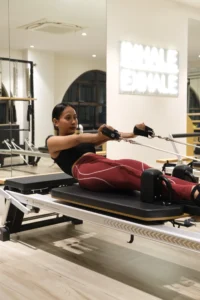
Reformer Pilates for Office Workers
Reformer Pilates can provide another way for office workers to develop strength, stability, mobility and body awareness.
The reformer uses springs and a moving carriage to provide adjustable resistance. Exercises can be adapted for different fitness levels under the guidance of an instructor.
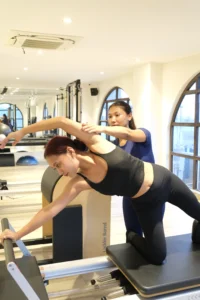
For beginners, supervised sessions can be especially useful because an instructor can help with:
- Exercise technique
- Alignment
- Breathing
- Resistance selection
- Movement control
- Exercise modifications
- Progression
The goal should be quality of movement rather than simply completing as many repetitions as possible.
How Often Should Office Workers Do Pilates?
There is no single frequency that works for everyone.
A beginner might start with 2–3 Pilates sessions per week, while maintaining regular movement during the working day.
Consistency is generally more practical than attempting an intense workout occasionally.
Your routine can also combine Pilates with:
- Walking
- Strength training
- Mobility exercises
- Cardiovascular exercise
- Recreational activities
A balanced programme can help address different aspects of physical fitness.
Simple Desk Habits to Combine With Pilates
Pilates for Office Workers works best when combined with healthier workplace habits.
Adjust Your Screen
Keep your screen positioned so you do not have to constantly bend your neck downward.
Change Positions
Avoid treating your chair as a place where you must remain completely still.
Take Movement Breaks
Stand, walk or perform gentle movements throughout the day.
Relax Your Shoulders
Many people unconsciously raise or tense their shoulders while concentrating.
Move Beyond the Desk
Walking, exercising and participating in activities outside working hours can complement your Pilates routine.
Build Strength Gradually
Do not attempt advanced Pilates exercises simply because they look easy online. Progress should match your current ability.
Who Can Benefit From Pilates for Office Workers?
Pilates for Office Workers may be suitable for people who:
- Work at a computer for several hours
- Spend much of the day sitting
- Want to improve core strength
- Want to work on posture and body awareness
- Experience general stiffness from inactivity
- Want a low-impact exercise option
- Want to improve mobility and flexibility
- Are new to structured exercise
- Want to complement their existing fitness routine
However, individual needs vary. Anyone with an injury, persistent pain, recent surgery or a medical condition should seek appropriate professional guidance before starting a new exercise programme.
Why Choose Pilates Instead of Simply Stretching?
Stretching can feel good when your body is stiff, but flexibility is only one part of physical health.
Pilates can combine:
- Strength
- Mobility
- Stability
- Balance
- Coordination
- Core control
- Breathing
- Body awareness
For office workers, this combination can make Pilates a more comprehensive movement option than relying only on occasional stretching.
Making Pilates Part of Your Office-Wellness Routine
A successful exercise routine does not have to be complicated.
Start with manageable sessions, learn the fundamentals and gradually increase the challenge as your strength and control improve.
For someone who spends eight or more hours working at a desk, the goal should not simply be to exercise for one hour and then return to being completely inactive.
Instead, think about movement across the entire day.
Sit less. Move more. Strengthen your body. Take regular breaks. Practise good movement habits.
That is where Pilates for Office Workers can fit into a sustainable approach to workplace wellness.
Frequently Asked Questions About Pilates for Office Workers
Is Pilates good for office workers?
Yes. Pilates can be a useful exercise option for office workers because it focuses on core strength, controlled movement, mobility, stability and body awareness. Research also suggests Pilates may provide physical and occupational benefits for workers, although more high-quality research is needed.
Can Pilates help with back pain from sitting?
Pilates may help some people manage back-related symptoms by improving strength, mobility and movement control. Exercise programmes have shown benefits for low-back symptoms among office workers. However, persistent or severe pain should be evaluated by a qualified healthcare professional.
Can Pilates help office workers with neck pain?
Pilates may be helpful as part of an exercise programme for office workers experiencing neck-related discomfort. Research on exercise in office workers has found benefits from strengthening approaches, while recent research has also investigated Pilates specifically for chronic neck pain.
Does Pilates improve posture?
Pilates may help improve postural control and body awareness. A systematic review found evidence supporting Pilates for improving postural problems, although researchers noted limitations in the available studies.
How often should office workers do Pilates?
Many beginners can start with 2–3 sessions per week, depending on their fitness level and schedule. Regular movement breaks during the workday should complement structured Pilates sessions.
What are the best Pilates exercises for office workers?
Exercises such as pelvic tilts, bridges, Bird Dog, controlled spinal movements, shoulder exercises and mobility exercises can be incorporated into an office-worker Pilates programme. The most appropriate exercises depend on an individual’s ability and goals.
Is Reformer Pilates good for people with desk jobs?
Reformer Pilates can be a suitable option for office workers because exercises can be adjusted using spring resistance and performed under instructor guidance. It can help develop strength, stability, mobility and movement awareness.
Can Pilates fix bad posture from sitting?
Pilates cannot guarantee that it will “fix” posture, because posture is influenced by many factors. However, Pilates can help develop strength, mobility, coordination and awareness that may support healthier movement habits.
Can I do Pilates if I sit at a desk all day?
Yes. Pilates can be incorporated into a routine for people who spend much of the day sitting. It is also important to include regular standing, walking and movement breaks rather than relying solely on one exercise session.
How long should an office-worker Pilates session be?
The duration depends on your fitness level and goals. Beginners may start with shorter sessions and gradually progress. Even short exercise sessions can contribute to an active routine when performed consistently.
Is Pilates better than stretching for office workers?
Pilates and stretching serve different purposes. Stretching primarily targets flexibility, while Pilates can combine strength, mobility, stability, coordination and body awareness. Both can have a place in a balanced movement routine.
When should I do Pilates if I have a desk job?
You can practise Pilates before work, after work or during a suitable break. Many office workers find an after-work session convenient, while short mobility exercises can be incorporated throughout the working day.
Final Thoughts
Long hours at a desk do not have to mean accepting constant stiffness, poor movement habits or a weak core.
Pilates for Office Workers provides a structured way to work on strength, mobility, stability, posture and body awareness. When combined with regular movement breaks, walking and an appropriately arranged workstation, it can become part of a healthier working lifestyle.
For office professionals looking for a sustainable exercise routine, Pilates can offer more than a workout. It can help you become more aware of how you sit, stand, move and use your body throughout the day.
If you spend most of your working day at a desk, starting with simple, controlled Pilates exercises and progressing gradually may be a practical step toward becoming more active and movement-focused.
Contact Us
- Call: +91 69130 30757
- Email: ritualcentre@gmail.com
- Location: 5th Floor, Nikita Pinnacle, adjacent to Bank Of Baroda, opp. Taj Vivanta, Jaya Nagar, Khanapara, Guwahati, Assam 781022